Thursday, 21 May 2020

85. Ascension Day, a joint online service


One of the rules I set myself when I started this blog was to keep discovering new places. I had a rule against going back to the same place twice or more. It’s not a law of course, just something I think I’d like to stick to. But there have been exceptions. St Barnabas where it all began will probably remain my Christmas tradition, and I know I’ve featured Coventry Cathedral three times at least, reflecting perhaps the wide range of experiences you can have there.

I’ve been to both of these churches before. A fine sunny morning at St James in Old Milverton and a dark Sunday evening at St Mary Magdalene in Lillington. They were both very pleasant visits and reason enough to return but that’s impossible at the moment so their joint online service is the closest I’ll get for a while.

Today is Ascension Day, a feast to celebrate not only the ascent into heaven but the promise of a swift and glorious return. It’s a communion service with readings and prayers from people at home and a sermon filmed in the deserted grounds of the church. It’s been very entertaining to watch these online streamings develop from people staring blankly at their own laptop to more thoughtful, managed contributions. Apparently Ascension Day involves a need to replicate the mountain-top setting of the story by getting as high up as possible. Sadly an attempt to record prayers at the lofty summit of Chesterton Windmill was thwarted by strong winds and instead we get prayers from the attic. Nobody can say these churches aren’t resourceful.

For me Ascension Day is a key part of understanding the whole Christian religion. I know that’s a bold statement, and probably over-simplistic, but it has a basis of sorts. The traditional biggies in the calendar - Christmas and Easter - are in many ways all about belief. The stories provide the claims and the evidence and we have the choice of believing it happened or it didn’t. It’s the debate that’s kept people going for thousands of years. 

With the story of Ascension Day it’s slightly different. There’s plenty to judge when it comes to believing what did or didn’t happen, but there’s also the case of the promise made that the second coming was both imminent and certain. And because that was about something in the future it requires not belief that it happened but faith that it will. Faith in this context becomes almost the belief that something will in time come along that you can fully believe in, if that doesn’t sound too confused.

Faith is what sustains the faithful against arguments of lack of proof - when we can’t empirically know something, but still have an unshakable  conviction that it’s true. It’s no different in my mind from putting one’s faith in science to one day come up with the things we can’t even begin to understand or master now. 

And our faith has probably never been tested in our collective lifetime like it is at the moment. The facts that surround us are frightening - from the death toll to the job losses, financial hardship and turmoil. Everything looks bad, but there’s still faith. Few of us can make any claims to having expertise in theoretical economics but, while we have absolutely no idea how it will happen, we’re happy to put our faith in things somehow getting better. Faith, for whatever reason, is something we as people really need to cling on to.


Sunday, 17 May 2020

84. Some necessarily isolated thoughts

And so the lockdown goes on. This week’s minor relaxations have seen a lot more people out and about and some returning to work. It’s been a week of confusion over what we can and cannot do (and don’t get me started on how that fits in with what we should and shouldn’t do). It’s been a slight easing which has hinted at more to come. But the world is still a very, very long way from being back to normal. With social distancing still the operative buzzword there’s no chance of churches opening their doors just yet. I suppose even the shops and pubs would be open first. 

This will be the ninth post I’ve placed on my ‘looking at churches and the people in them’ blog with neither a church nor any people. No wonder then that I find myself wondering if now is the time to reach for the Back Soon signs.

Of course isolation itself plays a part in many religions - and certainly in the lives of those who choose to dedicate more than just each Friday lunchtime, Sabbath or Sunday morning to their followings. The Book of Saints lists many a hermit living out a truly solitary existence in cave or cell, and there are just as many Buddhists or Hindus taking vast unaccompanied walks into the lonely landscape of self-discovery. I could  perhaps follow in their metaphorical footsteps and use this isolated time to ponder everything from existence to meaning and then present my findings to this blog. I’ve certainly used the invocation to daily exercise and an excuse to head out for long solitary walks on which I have little to do other than think. But my theories would be no better-informed and certainly no more interesting than anyone else’s. So I won’t even start down that route.

When I started this blog at the end of 2018 it was with the intention, among others, of taking a closer look at what other people do when it comes to worship. During the time since I’ve been lucky enough to watch very different groups of people doing very different things all aiming, roughly, in the one direction. I never intended this loosely-termed pilgrimage to be a path toward any kind of enlightenment on my part; it’s not a search for the almighty. It was just curiosity and a spur to myself to get out and about more. And that’s why this current break in visits is so crippling. Because at the moment there re no people to go and watch and no places in which to go and watch them.

I’ve explored a little of what churches have to offer during this isolation period and it’s been truly inspiring to see how people have managed to keep connecting from their homes. But it’s not the same. I’ve read of congregations that the people make the church; I’ve read too of churches which inspire those who visit them to encounter fresh truths. Both are probably true, but with neither currently available it’s all a bit bleak.

There has been a lot of talk about the concept of the ‘new normal’. With the likelihood of the virus being conclusively beaten soon receding all the time, it’s certain we’re going to have to carry at least some of these new things we’ve been doing into whatever post-lockdown life we might arrive at. Social distancing, face masks, not touching and so on may well become the everyday facts of life. And that will have a huge impression on what happens with churches and other places of worship. You have to wonder of many of the older generation, still at risk from this virus, will actually feel like going back at all.

I hope they do. And I hope I shall be there to watch them and share their thoughts. The value of sharing time, space and experience with others is never more apparent than when it is absent. 


Sunday, 10 May 2020

83. The Litany of Reconciliation, Coventry Cathedral

There seems to have been an element of blurring about Friday’s events. With no lockdown in progress the day would probably have been wall-to-wall parades and parties,a very public demonstration of what, in many people’s eyes, are all the great things about this country. Overshadowed by the need to stay at home and keep our distance, the vast programme of happenings, whether military, civic, secular or religious, has been scrapped. Instead we have a nauseating diet of sentimental nonsense of TV and, where people’s desire to show the virus who’s boss is strong enough, sparse outdoor gatherings.

Somehow it’s almost as if the virus, not the might of Hitler’s war machine, were the enemy. And like in those dark times of threat and sacrifice, we must all band together and defeat this invader with stoicism, resolve and sheer Englishness. 

You would be utterly naive to think this had not occurred to the nation’s leaders; who, in these times of anxiety and stress would not want to be pictured as some sort of modern-day Churchill. It’s crass and cynical but there are plenty willing to lap it up.

I have nothing against reaffirming our undying thanks to the ordinary people whose sacrifices, both figurative and literal, helped preserve the freedom and way of life of this country. But as an excuse to hand out the beers and wave flags in the faces of our enemies - I’m afraid I’m not convinced.

VE Day itself MUST have been a celebration of course. And all the chest-beating tribalism utterly justified. But 75 years on surely everything bar the duty to say thanks has changed. We’ve had 75 years of reconciliation and the world is arguably a better place for it. It takes us to  remember what happened to us, recognise the hurt we caused others and reconcile the two - that’s the healing process.

If there’s one thing this cathedral is famous for it’s the fact that it was almost, though crucially not entirely, bombed out of existence. The chance to reflect in the ruins of the original building is as much a part of any visit here as the chance to marvel at its stunning replacement. From the moment the fires were finally extinguished and the words Father Forgive inscribed on the crumbled masonry, this place has been all about coming to terms with what happened and working to prevent its repetition. There are signs of reconciliation everywhere you look. Statues, crosses improvised from the remains, symbols of friendship and trust across national boundaries.

And of course the words. This lunchtime’s reading and reciting of the Litany of Reconciliation is perhaps the smallest service I’ve ever been to. Even more so because I can only ‘be there’ at the other end of a live stream. It comprises simply seven sentences of prayer and responses. Take away a mention of a link to another service and a spot of music from another event and this would be over and done in less than two minutes. Yet it still has a resonance and a power.

This service of the Litany of Reconciliation is especially moving today not because of this weekend’s anniversary and all the to-do surrounding it. It is moving and poignant because it is so everyday. Literally. These words, these hopes are said in this cathedral practically every day. Not as a huge banner parading, fanfare blasting colour spectacle, but a quiet daily reaffirmation often in the presence of only a few people.

A reminder that we don’t need pomp and circumstance, or fly-pasts, or bunting to say thank you, or say sorry, or promise to try harder in the future. It’s something we should do every day.


Sunday, 3 May 2020

82. Time to open the doors again

We’re all getting quite used to this. What started out as the complete upheaval of our daily lives has become the norm to the point where some of it is even habit. I set myself up in the spare room in the same way every day to work from home. I take the same breaks and go through the same routines. And once the computer is turned off and the mug returned to the kitchen, I sling my rucksack on my back and go out for my daily exercise via the shop if I need anything. Even the daily government updates have settled into such a predictable format that I can afford to ignore them and just check for any particular developments later.

I miss being in contact with people of course; that is by far the worst consequence of the lockdown. But I manage to find things to fill the time.  I’m even getting used to all my sport being about ten years old - it makes the disappointment of watching your team lose easy to avoid.
But this will all have to come to an end soon. The world HAS to get back to normal one day. And, if we’re to make any realistic start on reversing the damage done to our communal and economic lives, that start will have to come soon.

But closing something is much easier than reopening it we are learning. How do you go about lifting restrictions completely without putting undue pressure on all those people we rely on when things get a little out of hand?

With pubs, shops and football you can see the obvious problem of people going, to slightly differing degrees, wild at the chance to be reunited with their passion. Not so with churches surely. While mosques and some evangelical congregations are used to being full, it’s hard to see the sparse gatherings at many of the more remote churches going on some all-day prayer bender and piling more pressure on the NHS.

The online communities of many of the churches and other places of worship have been busy speculating how re-opening the churches while still observing the rigours of social distancing might impact on the way things are done. Sitting at a distance, as previously mentioned, might not be a problem. The direct contact of communion or healing may have to be sidelined for a while longer. In some churches it’s even been mooted that hymns and singing be halted for fear we shall all be firing out clouds of Covid-drenched air in our zeal. It’s probably a good point.

There would be a clear problem in meeting any restrictions on age though and with the government keen to avoid letting the vulnerable back into potential danger in the first wave of relaxing restrictions, this could be tricky. In many of the churches I’ve visited I have been the youngest person there even as I approach 60. Many of the smaller churches rely on retired clergy returning to keep services going. 

But churches - and for that matter temples, mosques and other holy places - are more than just the weekly programme of services and meetings they offer. They are a focal point for those who rely on them and they offer a constant place of refuge from the worries and stresses of daily life wherever you may be in life’s long journey. For many, particularly the elderly, being denied the opportunity to pop into church outside the ‘normal hours of business’ has been the biggest blow of the lockdown. 

And it’s here that the solution may lie. Could not our churches take a lead from the supermarkets and offer times when access is allowed only to the vulnerable? Those leading our religious communities have shown remarkable versatility in maintaining worship. I think both they - and the churchgoing community itself - have the common sense and the adaptability to make things work. 

The government has been necessarily strong in dictating what we can and can’t do in lockdown. And for the most part we have all respected that strong position and knuckled under for the greater good. But the government needs to be strong enough now to hand back that responsibility to those who have been ensuring society runs smoothly for the benefit of all for generations. It is time, though with a measure of calm caution, to open the church doors again.


Sunday, 26 April 2020

81. Online and home meditation


Life generally seems to have so much meaningless clutter that there is no time for exploring its meaning. Or even beginning to think about it.

This lockdown has, in many ways, provided a very fertile environment for contemplative thought. We can’t really go anywhere and so many of the things we thought we couldn’t do without, we are now doing without. Every excuse then to turn off the TV and the phone and indulge in some meditative experiments. 

Unless you are in the blissful position of having little in the way of physical and mental distractions - no stressful journey to work, no bickering office politics, no noisy neighbours or demanding family - then you’ll be battling the problem of how to fit in any time for quiet contemplation.

You can’t go to a group session at the moment of course, however simple it would be to stick to social distancing while sitting on the floor. But there are lots of offerings online. Try googling or looking on YouTube - there’s everything from the plainly whacky to the blissfully simple and instructive. The idea of meditation has always carried different connotations for different people. Kaftans and sixties hippies, Beatle followers, weird chanting, incense sticks and so on. It’s all still there but there’s a growing layer of personal development thought and mind-management theory perfect for the self-help book generation.

Over the years I have tried a fair selection of elements of meditation. I’ve been led deep into my own breathing in a chapel in Warwick, I’ve joined proper monastery monks beneath the giant Buddha in Hong Kong, I’ve escaped the lunchtime shoppers for an hour at a Leicester centre and spent an evening for this blog wondering how long I can sit still through abject pain at a retreat near Stratford. Different levels and approaches but all with one aim in mind - to focus the thoughts by shutting out the outside world and its distractions. In the end, like everything from fitness to food, you just take the parts that work for you and stick to that. A self-help writer would turn that into a whole book on putting the ME into MEditation, but I shall resist.

For me the concept of thinking about not thinking is an early stumbling block. Many meditation session leaders have invited me to empty my mind completely. As a literal phrase it’s always struck me as daft. Daft and unachievable. What I DO need however, is to (at least temporarily) stop the galloping nonsense which seems to monopolise my thoughts every waking moment.

The thing is I am not seeking glittering truths or life-changing pathways, not even anything particularly profound. I just want a way of stepping away from the madness of everyday stress and concerns, and the chance to press reset on my equilibrium. A lot of people arrive at this through techniques associated more with mental health which have come to be grouped under the term Mindfulness. Colouring books, contemplating flowers, listening to one specific sound only - all with the aim of being in the moment, and therefore NOT embroiled in all the non-existent moments we imagine ourselves to be contending with. 

Oddly enough I find I’ve been doing this for years thanks to a calming technique I learned when transcendental meditation was the buzzword of its time. It’s easy and utterly without danger.

My tip for a meditative experiment would be to get comfy (no sitting on the floor for me!) and know you have at least fifteen minutes. Put on a quiet piece of music lasting that time so you’ll know when you’ve finished. Close your eyes and just be aware of gradually slowing your breathing down. Imagine walking on a very familiar route (I still choose the walk to school I haven’t actually trodden for over 40 years). Imagine yourself setting out on that walk with no need to hurry. Picture the route from your perspective as a walker in very small stages, pausing as you go to remind yourself of the detail around you. Turning a corner in a street might make you think what you would see on the other side of the road, a garden you always pass, a sign on the wall. It’s surprising how placing yourself somewhere begins to lead to even more detailed memories of the buildings, roads, landmarks and so on that you pass. Don’t be frightened to stop along the way and look around you. As you go you might, right in the back of your mind, become aware of how this one simple occupation has pushed the boiling mass of confusion we normally carry in our heads, right out of the way. If filling your mind with calm thoughts sends the racing nonsense out of sight for a while, then Job Done.

And that’s it really. No deep understanding of life’s meaning, no corruscating vision of the Almighty, no spiritual enlightenment. Just a few moments away from the madness. And we can all use that.


Monday, 20 April 2020

80. Stella Bailey, St Nicholas Church, Kenilworth

This week I was pleased to do two jobs at once by chatting with Rev Stella Bailey both for this blog and for the newspaper I work for.

Easter is a busy time for churches. It is, for many faiths, the most important time on the calendar.

They can expect to be filled with worshippers remembering the Crucifixion and the returning from the dead. Families meeting for Easter make it part of their tradition and even the very young can be tempted along by the prospect of the odd chocolate egg.

This year is, of course, completely different. Virus measures have left the churches - along with almost everywhere else - empty and locked.

At a time when we are repeatedly met with phrases describing our NHS workers as angels and proclaiming that they, and the people they care for, are in our thoughts and prayers, the very places where you might expect to find people voicing those prayers are closed.

There is a fairly threadbare joke about vicars only working one day of the week, and with that now taken away they should - if the joke holds true - have absolutely nothing to do at all. But that’s not the case. These unparalleled times find vicars busier than ever.

The Rev Stella Bailey, vicar at Kenilworth’s St Nicholas Church, is, like many of her calling, having to come to terms with the challenges and opportunities the current stay-at-home message presents.
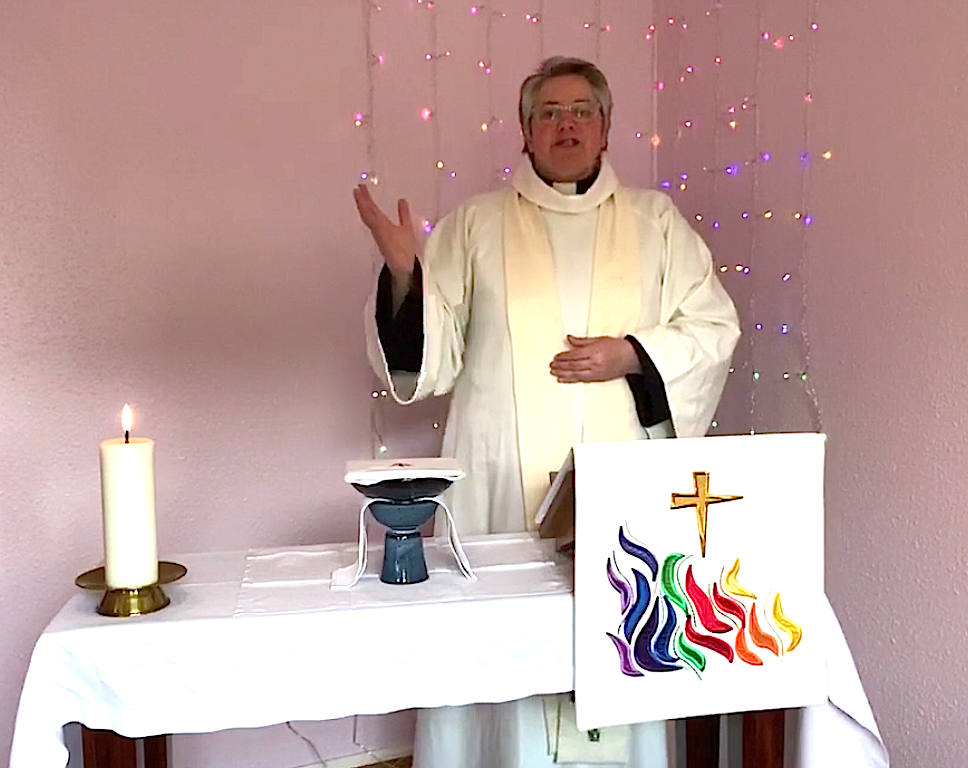
For the past few weeks Stella has been live-streaming services from her home - a makeshift dining room corner embellished with a few handy artefacts brought over from the church. For this weekend’s live service there’s even a backdrop of coloured lights. Making the transition between the familiar Sunday service and the new online offering has been little short of a crash course.

"It has been about presenting people with something which is authentic to the church community while also thinking ‘how can I do it within this context?’
"We did have a bit of time to anticipate it happening before lockdown arrived. We were keeping an eye on what was happening in other countries and we were able to warn people that the only way we could continue to offer regular worship would be through Facebook.
"But I do miss the eye contact with the people I’m talking to. There’s a feeling of being disconnected. At times I’ve been on my own in the house and so services have felt very cold."

Some comfort has come through the fact that services are now being enjoyed by people from much further afield. People who have moved out of the area or those who have relatives in the parish are joining in helping to spread the connection further.

"Normally I’m trying to find ways to make the church relevant and attractive to people in their twenties. Now it’s flipped. It’s now the older people I am concerned about staying connected to. In particular those people who are in IT poverty and don’t have access to Facebook and so on."
To meet this need Stella has recently been recording spoken word versions of worship which can be delivered to those who can’t join in the church’s life online.
The response within the community to thse fighting the virus has been something which has moved the whole nation. Expressing our thanks to NHS frontline staff, people collecting our bins and delivering essential services may be something which lives on once the country emerges from this time. But the lesson we have learned is one which, in Stella’s view, must not be forgotten and must be acted upon.

"The clapping and support for those people we rely on has been welcome. But the clapping means nothing if it doesn’t lead to policy changes.
"The time to show how much these people really matter is at the ballot box."

Away from the Sunday duties, life for the parish vicar in these times has been far from easy.
Weddings have had to be called off - some within a very short time of being held. And while one of life’s big family celebrations can be rescheduled for next year, the same cannot be said of funerals. And these are weighing heavily.

Before the virus began to take its toll and the numbers of the dead start to rise in hundreds a day, St Nicholas Church could expect to find around four funerals a month in the diary. Now that figure stands at ten per week. And restrictions mean the funerals themselves are affected.
"The funerals are horrid. Most of them are directly at the graveside or the crematorium and are shortened services with only four people allowed for Warwickshire and five for Coventry. Often you can only speak to the family on the telephone.

"While you are presenting a person’s body before God, there is no opportunity to celebrate that person’s life."
Memorial services months later could become one of the legacies of this crisis and Stella hopes to allow families the chance to take another step on the grieving process.

The prospect of an end to the lockdown and the re-opening of the church doors is something treated with both joy and caution. The world into which we emerge may well be radically changed and new challenges will have to be faced. But the never-changing calendar of the church at least gives reassurance that there will another Easter.

To join Stella for her live-stream services and catch up with those you’ve missed visit stnicholaskenilworth.org.uk.

Friday, 10 April 2020

79. Notre-Dame de Paris

One of the great things about not being allowed to go anywhere is that you can go anywhere. 

There was a time when being sent to your room in solitary shame meant being cut off from the world. Now, without the prospect of another person sharing the room with me for many weeks, I’m able to travel, meet, converse and experience as I wish. If only it were real, I keep reminding myself. Because it isn’t.

Good Friday finds me taking a virtual stroll past the bookshops on the left bank, crossing the Seine and heading through the imposing doors of Notre Dame. All thanks to live-streaming of course.

It’s a year, give or take a few days, since this familiar Paris view could be seen on any TV screen around the world enveloped in the flames of the unthinkable fire that turned it from a symbol of faith and history into a blackened, smoking ruin, its spire and roof gone for ever.

It was a truly terrible time, the closest many of us will get to understanding what it was like to wake up the morning after the bombing of Coventry. History is, it would seem, not there forever.

An overwhelming tidal wave of support doused the flames somewhat and, a year on, the work is continuing - although it seems to have moved from the uplifting community stage to the bickering politician stage. Today represents a rare chance to take a look inside.

Because of the nationwide French lockdown, only seven people attended the service in person. The annual observance of Holy Week in all its pomp, a fixture on the catholic world’s calendar, is for the most part off or forced to find new arenas. 

For the short service the cathedral’s archbishop symbolically brought with him the fabulous golden crown of thorns snatched from flames. This was supposed to be a moment when the priceless relic overcame the devastation of the blaze. It may have done that, but the people chosen to transport it have yet to come through their own equally devastating challenge. Rescued and restored it currently lives elsewhere.

Planned as a veneration offering the chance to reflect on the fire, the year of restoration and the current pandemic, we also enjoyed readings from a variety of poets read by two stars of the French acting community. Music came entirely from a solo violinist, a haunting voice in the cavernous space.

It was an odd sight throughout, as many of these live streamed services seem to be. The clerical contingent of four arrived complete with hard hats - this is a construction site after all - to be met by the trio of performers clad in full anti-contamination suits and Wellington boots. Even in these other-worldly times, nobody does costumes quite like the Catholic church.

The service - fine readings and moving address testing my surprisingly still workable understanding of the french language - takes place at the foot of a giant golden cross halfway down the cathedral. Behind it scaffolding and damaged stonework extend upwards. Close-up shots of surviving windows and artefacts tail off into a dark, smoke-stained gloom you can almost smell through your computer screen. There’s still a lot to be done Mr Macron.

First the building and now the people who treasure it, everything has to prove it can endure whatever time decides will be put in its way. I’m sure we will one day see far better times for the cathedral and its worshippers but at the moment, with thousands being added to the death toll every day, it’s as great a test of faith as you can imagine.