Sunday, 29 September 2019

51. Unitarian Chapel, Warwick

This pilgrimage has been characterised by comparisons. I have been struck by the similarities between churches working under the Christian banner. But I have been even more surprised by the differences. For a huge swathe of humanity nominally following the same God and (more or less) the same teachings of one man, there’s an awful lot to choose from. And it is a choice. I’m reminded of a whisky map I once saw. Two axes charted the desired level of smokiness or peat influence, the darkness or lightness and so on. By sliding around to your favourite area (dark and smoky with the merest hint of peat) you could read off the single malt that’s right for you.

Today’s visit to the Unitarian Chapel in Warwick sees me among people who have sited their choice on the equivalent spiritual map a long way from the pomp and circumstance, the regalia and ceremony of many churches, without - it has to be said - actually making a decision to stay on that part of the map. There’s prayer and bible reading and some lustily-sung hymns but it’s very low-key and there are constant reminders to make up your own mind about what you believe. Keep that finger free to choose wherever it wants to go. Unitarianism is all about what you want it to be about you could say. 

The Unitarian Chapel is a lovely little single-room space much loved by chamber concert organisers and meditation groups among others who share this venue with its resident worshippers. There are only about a dozen people here and we sit is a wide semi-circle to focus on the plain table and lectern. There’s a coffee table in the centre with a simple bunch of flowers and a single candle. 

Talking to a few people at this short service, it seems that many are on a journey (apologies for using that hackneyed word but Strictly Come Dancing has just returned to the Saturday evening schedule). I had a long talk with one chap whose spiritual travels have taken him from his Catholic roots, through a spell with Anglicanism and then via short bursts of experimentation including Evangelism. Comparing notes,I find his experience not dissimilar to my own. 

More than one person spoke to me of having arrived at Unitarianism through a liking of its lack of dogma. There’s no creed to recite and it’s clear that all those present can hold slightly (but importantly) differing views and yet be happy with that position.

Today’s service is led by Angela, a visitor from a chapel in Birmingham. She gets to do pretty much everything - prayers, readings and (in lieu of a sermon) an address on the theme of the day, who was Jesus?

Angela peppers the service with a clutch of readings from Khalil Gibran’s collection of character studies of Jesus from the perspective of people who may have shared experiences with him. We hear reflections on, among other aspects, Jesus the prophet and Jesus the bespoke carpenter.

During her address Angela relates what was said at a recent funeral she attended. In listening to a member of the family saying a few words about the departed, she noted how we can all have a different view on what a person was like. Broadly we’ll probably pick out the same things, but to a greater or lesser extent. and with a different priority.

Perhaps Jesus is a bit like that. Certainly to Unitarians. Unlike more dogmatic faiths which preach a particular view, however broad or narrow that might be, it’s for Unitarians to make up their own minds. We have no particular reason NOT to accept some historic evidence that Jesus lived. What you believe beyond that, and what you think that means for your own life, will dictate your answer to the question Who was Jesus?

It would be easy to view Unitarianism as being some sort of Christianity-Lite - a religion with all the bits you object to removed. But that wouldn’t really be fair. This gathering did not feel like at all like watered-down worship. There was a palpable commitment to follow the Christian path and to respect the right of others to tag along for any part of the route they wished to cover.

This pleasingly ‘suit-yourself’ approach to faith is attractive in many respects, perfect for someone forming their own opinions whilst enjoying swapping views with others. Not happy with the creed up the road or the evangelistic outpourings across town? There’s a place of calm acceptance right here.

It is easy to see how this casual approach would tempt many away from faiths where they may feel at odds with parts of what goes on. Given, however that there are so few people here, it would perhaps be more instructive to know what tempts them to regard this as a stopping point on the journey rather than a lasting destination.


Sunday, 22 September 2019

50. Grosvenor Road Christadelphian Hall


Have you ever read Dracula? It’s a story everyone’s familiar with. We all know about the vampire’s bite, the Transylvanian castle, the flowing cloak, the stake through the heart and so on - we’ve seen it in countless films and lampooned in comedy sketches and TV adverts. But have you actually read it? 

I only ask because I have, and it’s a brilliant book. Twice as scary as any film and full of bits most filmmakers opt to leave out. Sometimes, it seems, we’re happy just to know the gist of the story without feeling the need to dig any deeper or consult the original.

These thoughts are in my head because I’m visiting Coventry’s Christadelphians this morning and when it comes to reading the Bible, they have an essential connection with the original far more diligent than many. The Bible contains the word of God and, for this congregation, offers everything you need to live and to understand what’s important. Read it, read it again, study it and then study it again, appears to be the way to go.

The Christadelphian Hall in Grosvenor Road is another church which falls into the over-stuffed category of ‘places I’ve walked past a thousand times but never gone inside’. It’s a modern hall, clean and light inside and there’s a very healthy gathering for this ‘breaking of bread’ service. The welcome is essentially warm - as it remains throughout - but my arrival is met by quite a few suspicious questions. 

But there are handshakes too and a bit of welcome help when it comes to finding passages in the bible - listening to the readings is,it becomes apparent, not the full picture. You have to read the words and see for yourself every reference. It’s a very studious, slightly introspective approach but, I should note, that the congregation also produce the best hymn singing I’ve heard for a long while so it’s not all kept inside.

Today’s parables include the story of the prodigal son. It’s one I think I’m familiar with but a complete, deliberate reading acquaints me with details I didn’t know. Whether ‘going back to the original words’ allows me to understand more in this case is a moot point. It is a parable after all and its meaning is to some extent metaphorical rather than relying on exact literal details. Once you’ve grasped the meaning and the underlying thrust of a parable, you may, I suspect, have taken all you can. But this morning is a clear example of how the strong Bible-based church works.

In keeping with this almost library like, forensic approach to the Bible’s historic text, there is a studious feel to the whole morning. There are lengthy silences throughout the service, and a quiet way of going about things.

The breaking of bread part of the service is not available to those not baptised in the Christadelphian church - how different from last week at Ashow when I was invited to join in regardless of faith and previous commitment. But that’s just the way things are and this church is very serious when it comes to looking after its own members. Perhaps that’s why my standard enquiry about taking pictures after the service was politely but firmly turned down.

The Christadelphians are a tight brotherhood and perhaps a little inward-looking. All the prayers offered this morning are for members of the church and the exhortation given is a call to everyone to reaffirm their commitment to the church and its beliefs and practices. There’s very little, if any, by way of urging worshippers to go out and help in the local community. 

Knowing a book thoroughly is rewarding and there is value in consistently going back to it to see if any more can be gleaned. But there’s also value in occasionally looking up from that book and seeing what’s going on outside your study window. 


Sunday, 15 September 2019

49. Ashow Church


This has been a weekend for things drawing to a close. I enjoyed the Last Night of the Proms but I’m always slightly sad to see the season end. It’s the same with the cricket as the Ashes series nears completion. Soon it will be football and Strictly - just as enjoyable for me but proof of another shift in the calendar.

We get very used to things being in the same place in a calendar year and, with that familiarity, it’s easy to build up a resistance to change. The same is true in the church calendar I should expect. We know where we are with Easter, harvest, Christmas and so on. No need to change things, just let matters continue as they have for generations. But complacency can be dangerous.

Ashow Church this morning is in ‘Ordinary Time’. I’ve not come across this before but it seems like a period which is not part of a set-down festival. A free lesson on the timetable perhaps. The church’s own choice of what to focus on. 

It’s certainly a chance to take a step back and reassess, an opportunity to do some housekeeping too, both physically and mentally. And, as becomes apparent, there’s a great need for that.

The Assumption of Our Lady church, to give it its full name, is a very attractive church. It sits on the edge of the village overlooking the passing river and is a recognisable point along quite a few country walking routes. By chance I’ve chosen to walk here this morning along a path and lane from Kenilworth. It’s a good way to arrive but as I always do, I’ve set off far too early and I’m rewarded with half an hour’s reading on a very pleasant bench.

Inside, the church is traditional. There are wonderful pews with high screen surrounds. I think I like these rather in the way I always fancied having a box at the theatre.  

I am also quite taken with the splendid compact organ. It only has the one small manual and fewer than half a dozen stops but the sound is good and, in the hands of a decent player, we’re even treated to a spot of Bach. It’s all the more engaging because the organist has the shallowest of platforms and his stool has to be kept level by the strategic placing of two small piles of hymn books.

It’s a standard communion service but with one difference. Instead of preaching a sermon, the vicar Nikki Moon has chosen to address a few words about the position in which the church finds itself.

In common with many of the fine old buildings whose presence we take for granted, this church needs work to halt the ravages of time and the weather. Church repairs are never cheap and there will have to be some very active fund-raising to pay for what needs to be done. But the crumbling fabric of the building is, you’d have to say, not as pressing as the problem which lies within.

Nikki is vicar to more than one church. Like many I’ve encountered on my travels she has to divide time between flocks. If the churches are close enough and time permits, it can be done. But time is the problem here. Being vicar of Ashow and Stoneleigh is deemed to be a part time role. Nikki’s time covering the job is coming to a close and the viability of both churches surviving with one part-time 20-hour vicar is questionable - particularly with another long-term reader becoming unavailable and nobody steeping forward so far. 

So the message to the congregation is clear: Take up some of the strain somehow or the future could be bleak. The trouble is that this crucial message is being given to fewer than a dozen people most of whom are already doing their bit. And this, to a certain extent is where I came in at the start of the year. Falling numbers and, without wishing to be indelicate, a steadily ageing congregation is a far from healthy position. 

From my wanderings this year I can only report that in some ways the good news is also the bad news. Ashow can take comfort from not being alone in its predicament - but the reason for that is that nobody else has yet come up with a guaranteed, rapid route back to health. Cutting the number of services or sharing them around between similar churches is fine, but only as a way of disguising the paucity of attendees. What the church needs now - and not just in this tucked-away corner of the faith - is more people. A lot more people

Judging by the confusion, disillusionment and grief sweeping this divided country at the moment, there are an awful lot of people around in need of a calm. clear direction. Periods of trouble and worry are traditionally prosperous recruiting times for the church. It’s just a simple task of getting them to come in through the doors and fill the pews. And in that task I don’t envy hard-working people like Nikki. 


Monday, 9 September 2019

48. Knowle Parish Church


It is, of course, a popular misconception that being a vicar is an easy job because you only have to work one day a week. I doubt anyone really believes that, but I’m sure many would be surprised by just how far from the truth the idea is. 

There’s a huge schedule of organisational duties, pastoral care, midweek meetings, community support and so on. And that’s before any thought can be given to the Sunday worship. He or she is a driving force as well as being the glue that holds the whole thing together. 

This church has been without its own vicar for about a year and, although normal life goes on with the help of visiting clergy and supporting assistants, it must be a huge relief to all to finally fill the vacancy.

And that’s why I’m here tonight. I’ve always liked the look of this church, a familiar sight on my way into Solihull for so many years, but I’ve never been in. Tonight is the service of induction for Geoff Lanham who will be the new vicar.

Knowle Parish Church - properly named Church of John the Baptist, Saint Lawrence and Saint Anne - is a big and very traditional-looking church. It has a large nave with decent side aisles and tonight every pew is packed. There are even additional plastic chairs in the central aisle and a few seats at the back. The sidesmen are acting as makeshift usherettes looking for gaps to be filled and trying to make sure everyone has a view. At the front no fewer than four big video screens mean even those tucked behind the hefty stone pillars don’t miss a thing.

The regular congregation are here of course, impatient to get a look at the new man. But there are also civic dignitaries and quite a sprinkling of clergy from other churches. I arrived with the minister from the nearby Methodist church, keen to support a fellow member of the profession. 

It’s a big service to match the big crowd. The Bishop of Aston presides over the bulk of a long service and adds a welcome touch of levity amid all the rigmarole. She makes regular allusions to the church as a ship setting out on a new voyage with a fresh face at the helm. Geoff is the skipper taking over an established crew. It’s a theme we keep returning to. 

The induction of a vicar comes with a lot of promises. Promises on the congregation’s behalf to welcome the new incumbent, and promises from the new shepherd to lead his flock with wisdom and compassion. In some ways it reminds me of the promises made by all sides at a Christening. It stems from the days before the mass of criminal database checks in our modern commitment to safeguarding, but somehow an undertaking made before God and your future congregation is probably just as weighty.

There’s a pleasing eccentricity to part of the proceedings. The new man is placed in the vicar’s chair and invited to lead a prayer from there. He’s then paraded down to the door of the church where his hand it placed on the door handle and, following a ceremonial tug on the bell rope, he gets the keys to his new church.

Having been given the official nod, one of the vicar’s first duties seems to be to accept a whole raft of responsibilities from representatives of the wider community.

The school governors will be requiring his input, the church wardens and youth leaders likewise. And from the mayor of the borough a very firm hint that his presence in the Lions fun run wouldn’t go amiss. The vicar’s busy time just got a whole lot busier it would seem.

A few splendidly-sung hymns later and it’s time for refreshments in the hall, plenty of handshakes and a groaning table of cakes. Those in charge of the baking have certainly made the warmth of their welcome abundantly evident.

And now the work starts. It must be daunting in a way. Joining any group as established as a well-attended church is hard enough. But to join it in the position of its new leader must provide added challenges. All churches have their ways of doing things. So. I firmly expect, do all vicars. As I head back into the night I only hope that whatever niggles there may be are suitably outweighed by the optimism and willingness so clearly on display throughout this service.


Sunday, 8 September 2019

47. https://everyday.org.uk/online/

Yesterday I bought a book without going to a bookshop. I also kept up with a few friends without having the inconvenience of actually meeting them and I even managed to check the weather without having to open the curtains.

We’re all familiar with the online world and how it has changed the way we live. It used to be something we might worry about; If I had a pound for every person who told me the newspapers I produce would become extinct in a year, I’d be able to retire from my job at the newspaper. I suppose they are gradually going - as are many of the shops which sold them - but we’re just that bit more used to the change going on.

There have always been people who prefer the trappings of social interaction to come to them. Think of all those people who bought the record rather than go to the gig. Many people I know prefer to wait for the DVD rather than run the gauntlet of noise, phone lights and the smell of fast food which constitutes any visit to the cinema these days.

But people’s migration to online living leaves us with many social spaces less well attended than before. Perhaps the paucity of worshippers at many services is a reflection not of people’s disenchantment with what the church offers, more that they just don’t want to actually turn up week after week.

Cue the online church. It’s a place you can visit, join prayer, sing praises, hear a sermon and so on without ever leaving your home. It’s a church - and a whole religion to back it up - which you can carry round on your phone just as you carry the gossip of friends, Jacob Rees-Mogg memes, hours of music, up-to-the-moment cricket scores or unlimited porn.

After a brief and not altogether successful Google I’ve found the Everyday Online church and with an hourly service starting in four minutes, I’ve barely time to find some headphones and make a coffee before I’m off to church.

The name Everyday Online has me pondering. Everyday mean normal, ordinary, humdrum even. Every day, on the other hand, means a constant presence. It could be a mistake; it could be a sassy attempt to cover both bases or even invite a comparison between the two. Oddly enough Ikea are currently using the same spelling. You have to wonder where in the spectrum of subtle or ignorant it lies. There is, as Nigel Tufnell once said, a very thin line between clever and stupid.

Everyday Church is not entirely virtual. There are a string of real, solid South London churches behind this website. But it’s the online incarnation which interests me. Click on the site and you can join any service live. Each service lasts an hour and includes much of what you’d expect to encounter if you pulled up to one of their real churches in Croydon or Wimbledon. There’s a welcome, some extremely well-produced music from the band complete with singalong lyrics, the option to join prayers and a lengthy sermon in the form of a lecture.

Darren is our online pastor, ironically he’s pictured against a background of a completely empty church. Giving the sermon is Phil. There are buttons to click to chat live with other worshippers or type in your request for a prayer. The sermon is backed up by exhaustive notes for those who want to delve deeper into its themes. 

It’s a decent theme this morning. There are three key directions Jesus works, says Phil. In towards the the church family, up towards God and out into the wider world. Too many people - and too many churches - only cover two of those dimensions. Time to throw away your 2D Jesus and usher in the 3D saviour. And that he does - giving a fearful whack to the cardboard cut-out Jesus he’s been sharing the screen with. 

It’s a compelling lecture full of references, philosophical and scriptural back-ups and delivered in a very watchable fashion. I can think of plenty of places I’ve been to where this standard of preaching would open up a few eyes.

But absorbing as Phil is, he’s up against all the other distractions of being online. I’m drawn to the live chat as we go along, and the live request-a-prayer - although my request for the online community to pray for me to get round the afternoon’s cycling challenge in Coventry is shunted into the cul-de-sac of ‘someone will be with you shortly’.

I find myself wondering if Phil will notice if I just check the latest on Brexit resignations, order some more socks or have a quick game of solitaire. Such distractions exist in church, of course, but this seems relatively risk free.

Ultimately the online church route lives or dies on what it is you actually want.  There may be any number of reasons why people are in the unfortunate position of not being able to go to church and this could provide an option to them. But for those of us who can still attend, it’s a fairly straight question of where in your list of priorities you place genuine human contact. This is convenient, free (if you ignore all the ‘donate now’ buttons and banners) and only takes as long as it takes to watch. Do you really need to venture out and sit in a sparsely-populated building with a few others you only see once a week? 

Judging by the overwhelming majority of the places I’ve been so far this year and the enjoyment of the community identities they’ve built up over years, worshipping alone on your laptop still has a lot of folk to conquer. 


Sunday, 1 September 2019

46. St Paul’s, Leamington

This church has changed a lot since I was last here. Mind you that was about thirty years ago. Back then it was a rather sombre building inside and out.  A dark, towering place so close to the road that it looked far too big for where it was. Inside it was dark wood and small windows. I went here once for a wedding which I recall not being the lightest of events anyway.

Now, a complete remodelling has opened up the interior. The pews have gone and the modern seats allow for a multitude of configurations. The windows may somehow let in more light (there’s a lot less dark wood to soak it up), but that could also be down to the four big screens looming over the congregation. 

There’s a real sense of welcome to this church - always a sign that things are healthy and people are proud to share what they’ve got. It’s especially welcoming as this was not my intended visit this morning. A trip to Sydenham yielded not the vibrant church on the attractive website, but a set of closed and shuttered doors. That’s not the first time it’s happened - it’s a battle getting people through the doors sometimes so casualties are hardly surprising.

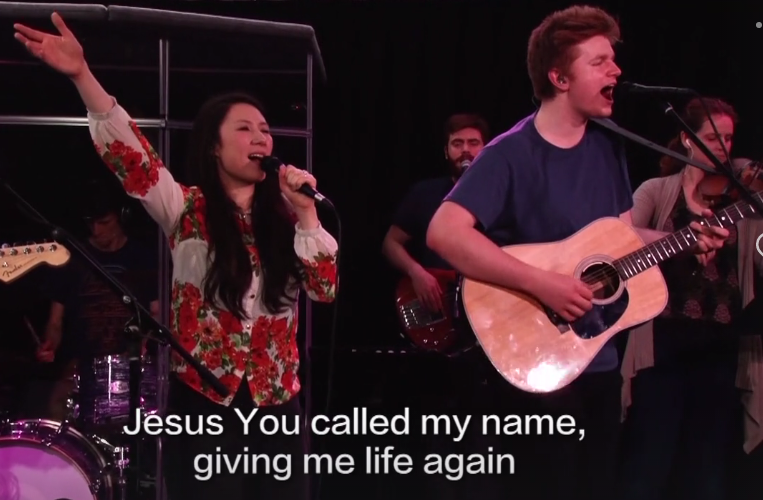
Today’s service is an all-age worship and it’s very well attended. I may have my qualms about the move away from hymns to a more modern sound but it’s certainly popular here. People of all ages are joining in - even when the lyrics on offer (and the actions which go with them) are definitely aimed at the under fives. 

Vicar Jonathan leads a series of prayers offering thanks for (and to) those who work so hard to run the various youth groups. And we’re treated to a very well-produced video of what some of those youngsters made of a recent Christian festival they went on. 

A video, a big screen, some music... could this be the influence of multimedia smart phone life coming through? Add to that a parable in the form of a children’s cartoon and a couple of lively presenters to analyse it and the whole sleek modern feel is there.

The parable for the morning is that of the prodigal son. I’ve always found this a difficult parable. Partly that’s because my deep-seated sense of morals leads me to believe the free-spending, selfish behaviour of the prodigal ought to end in some kind of comeuppance. It would in Shakespeare, in Dickens, in Enid Blyton. 

I know it’s a story underlining the forgiving, loving nature of parents (and through the parable, God) but it just seems unfinished. I’m happy with the idea of a forgiving God - it is after all the absolute basis of Christianity. I just stumble slightly at the idea there is nowhere you can go in life, physically or metaphorically, which is so far from God that you’d never be forgiven. 

Many months ago I heard a Methodist minister attacking just this blanket absolutism when it came to always forgiving those who hurt us by turning the other cheek. She argued that there are some cases when we owe it to ourselves and those who might also be harmed in the future to refuse the other cheek and take action instead. I thought it was very brave and very laudable then and I wonder what she’d make of this reading of the parable today.

I think her message of ‘sometimes enough is enough’ could extend to there perhaps being some things that God would not forgive. Some actions which go beyond what even divine grace could sweep aside. I’m sure everyone could think of a few. As parents we know there is much that we’d forgive from our children and that love will always drive us to err on the side of compassion. But there MUST be things that lie beyond that line surely?

Hopefully, as this is a rare chance for me to be accompanied by my daughter before she heads off to university, it’s a theoretical line we’ll never have to explore. 


Sunday, 25 August 2019

45. Holy Trinity, Leamington


I got married in this church 32 years ago this weekend. We chose it because we wanted somewhere close to where we were living and it seemed a good, solid church. It still does - hemmed in by parking shoppers but still with enough big trees to look the part.

Not a lot survives from that day. I still have an album of photographs - all taken indoors as a fairly hefty summer shower pelted down outside. The photographs have begun to look a bit dated I suppose; a cross between hire-shop traditional for the men and best eighties hats for the women. My side of the church was significantly less full on the day. I come from a non-churchgoing background - I’m not sure my mother had seen the inside of a church since her own wedding. She would debate theology with anyone and was fascinated by other cultures, including the Jewish element in her own upbringing, but church was not part of our family life.

It was the first time in ages I had seen my father, mother and sister all in one place. It was never repeated and, unless the afterlife permits such things, never will be again. Thirty two years have seen a lot of changes.

In some ways this morning has been about things which don’t change and things which do. There may be a new face looking out from the pulpit - and after 32 years why wouldn’t there be? - but the fabric and feel of the church is pretty much the same. There's a huge stack of roof tiles beside the altar, testament to the fact that even 'no change' takes its toll. An invitation to pray for the roof repair team is heartfelt.

I recall it being a church which drew the bulk of its congregation from the burgeoning retirement homes and properties in North Leamington. I recall too, the vicar at the time regularly choosing his time in the pulpit to warn these decidedly senior folk about the dangers of fornication and suchlike. The new curate Esther assures me that’s one thing that has changed.

After a series of services accompanied by guitars, keyboards and drums, it is both a pleasure and a relief to hear that Holy Trinity still boasts a fine organ and the personnel to play it. There’s something about the combination of church organ and some inspirational hymn words. I’ve wondered what makes people choose a particular church and - despite being a guitar player myself - this dependable, solid sound would be a must for me.

Another thing which hasn’t changed is that the organist who played at the wedding back in 1987 is in church this morning. He’s not at the keys as he’s taking a day off but it’s pleasant to remind him of what a fine role he played in our big day.

This morning’s readings provide an interesting theme. Based on the argument in the synagogue when Jesus decided to cure a crippled woman on  the Sabbath only to be chastised for working on a rest day, we’re invited to ponder which side of the fence we are when it comes to rigid rules or justifiable pragmatism.

It’s an interesting debate. From the point of view of the the woman it’s a no-brainer. I doubt she would care what day it was or which rule had been broken. It’s tempting to view the nit-picking attitude of the elders as being just that. Surely you’d make an exception for something so audacious and impressive as that? And when all’s said and done it was a fairly quick laying on of hands - goodness knows what they’d have made of the shift Ben Stokes put in this afternoon to win the test match at Headingley. Perhaps, though, we’ve grown more accustomed to rules - particularly religious rules - not being as set in stone as they literally once were. It would be a strange world if we reverted to the six-day format still in evidence when I was young.

Curate Esther makes the point that we should all have the courage, from time to time, to stand up against rules we see harming the people they claim to protect. It’s an excellent point. Failing to do just that has cost so much down the years inside the church and in the wider world. I have a suspicion that the coming months and years will provide plenty of opportunities for us all to demonstrate our willingness to question injustice.

Despite not being here for three decades I shall retain a soft spot for Holy Trinity. It’s a good working church with a tradition and past which seems to be in very capable hands. For the record - I sat on the groom’s side.