Sunday, 8 March 2020

74. Holy Ghost Zone, Coventry

This weekend has seen the threat of coronavirus spreading even further, bringing with it not only the prospect of further deaths - I believe the national figure stands at just two as I write - but a whole wave of rumour, concern, reaction, overreaction and more rumour. Who knows where we’ll be in a week’s time, let alone a bit further down the line.

At times of concern like this people turn to their faith. Maybe not in the form of thousands of new converts streaming into churches in the hope of deliverance, but certainly in the form of those who already go placing their trust not in the politicians and the scientists but in the Almighty. 

Last week the Church of England moved to advise clergy to avoid actual contact during services and to urge its congregation to shelve the traditional handshakes just for the present. Today the hands are very much in evidence - held aloft, clapping to the rhythm and rattling the living daylights out of more tambourines than I’ve ever seen in one place.

The Holy Ghost Zone in Hillfields is part of the Redeemed Christian Church of God. It’s based in a fine-looking red brick building right in the heart of this highly diverse part of the city. There’s a branch of the church in Leamington too but it was firmly shuttered-up when I attempted to go there. This one, though, is very much open.

It’s an early start for those who fancy joining in the pre-service Sunday School. This runs out to be not a colouring book session for the under fives but a detailed discussion on a topic led by a very convincing teacher. Today’s subject is, with one eye on International Women’s Day, the subject of why some people find it difficult to meet the right marriage partner. I’m not entirely sure ALL the women I know would see that as the ideal subject but, via a few verses from the Gospel and some decent audience contributions, a lively discussion ensued on what we as men and women could do to reduce the delay preventing us from fulfilling God’s wish that we all find some sort of wedded bliss.

The Sunday School gives way to the service itself and - as seems to be the case in quite a few churches now - we’re in the hands of the band to get things going.

Very decent musicians and an undeniably confident singer lead the way through the best part of an hour of extended songs with very limited lyrics but gutsy, soaring choruses and the chance to belt out some noise. This is where the tambourines come into play - not only and percussive accompaniment to the music, but as a kind of accentuation to spoken prayer. Only those with fully-charged hearing aids will know the shattering effect on the eardrums of a dozen out-of-control hand percussionists. It’s unbearable, so I retreat to the back of this large space for the remainder of my time. 

The effect on everyone else though is clearly profound. There’s something refreshingly unashamed about the way worshippers at churches like this connect with each other and with God - totally immersed in the moment and, in some cases, literally floored by the power of what’s going on. 

The prayers are not that dissimilar to the music in many ways. There’s a repetitive rhythm and an invocation to join in and shout out. It’s uplifting, cathartic and leaves those who lose themselves in it visibly invigorated. It’s also - dare I say it with the shadow of the virus creeping ever closer - highly infectious.

In the recent days I’ve heard a lot from the politicians and the science and medical community about ways of at least delaying the spread of coronavirus;  we must wash our hands while singing Happy Birthday, disinfect door handles and catch our sneezes the instant they threaten to emerge. I’ve not heard anyone talk about combatting the deadly threat simply through the power of prayer but, it that were remotely possible, I’d put my money on the Holy Ghost Zone leading the crusade.


Sunday, 1 March 2020

73. St Peter’s, Wellesbourne


You can get whole books of phrases we take for granted in everyday speech but which all come from Shakespeare. One fell swoop, the course of true love, heart on one’s sleeve, protesting too much, borrowers and lenders and so on. They become part of the fabric without us pausing for too long to wonder at their original context or specifically intended meaning. I’m sure the same is true for phrases which have made the short journey from the bible or the church into collective ownership. Even the most cursory Google search yields rise and shine, fight the good fight, wolf in sheep’s clothing, the powers that be and a whole host more. The one which springs to mind today is the concept of turning the other cheek. 

St Peter’s in Wellesbourne managed to make the news last week - albeit in a very local way. The vicar turned up one morning to discover, like thousands of others every week, that burglars had called. While the church was open to the public, someone had forced open a collection box and helped themselves to the contents. In the case of the other thousand people what follows has a familiar pattern - rage against the unfairness of it all, ring the police to try to get justice, ring the insurers and see if someone can compensate this loss and then lock the doors securely and resolve not to let the outside world in again. 

In the case of this church that hasn’t happened. Instead the vicar posted a polite note on the church door inviting those responsible to think about their actions and come along to a service where the forgiveness the church preaches would be put into practice. 

I’m curious as to how far this concept of turning the other cheek will stretch, and if there is a point at which one will simply run out of cheeks to turn. The note is still there as I arrive, as - at the back of the church - is a ripped-open donation box as a reminder to all. But that’s all there is - no mention is made of the missing money, or the damage caused in stealing it. 

St Peter’s has a decent, if slightly subdued, turnout for this family communion. It’s a fine airy church with the added bonus of a full set of bell ringers hard at work in their glass enclave.

This being Lent, the theme is about avoiding fairly hollow promises to forego chocolate or alcohol, concentrating instead on spending more time in personal and religious reflection. Self-denial is always secondary to self-education it would appear.

Perhaps this fairly inward-looking approach is designed not to pull in fresh numbers, but to make better Christians of the ones who are here. Trouble is, they all look decent and vice-free to me. Not for the first time I’m confident that I’m the youngest person here.

Restraint is certainly evident in some parts of the service. The continued spread of Coronavirus and the seeming certainty that things will get a lot worse, has forced the church into a reaction. The usual offering on peace in the form of a handshake is replaced by an awkward if well-intentioned nod.

When it comes to communion, those with even the suspicion of a cough or a cold are implored to skip the communion cup. We are all advised to keep washing our hands and informed that blessings will, for the time being, be administered to the head of the recipient with a virus-defying gap of a few inches. Never mind the chocolate or the wine, this Lent might see us all giving up human contact.


Saturday, 22 February 2020

72. Baitul Ehsan Ahmadiyyah Mosque, Leamington

All churches need to get more people in. Look within the doctrine of any religion and you’ll find it somewhere - spread the word, tell the people, grow. But, in addition to the hand that beckons, all churches need to reach out with a hand of friendship too - offered particularly in the direction of those who may be in danger of forming very unfriendly views. 

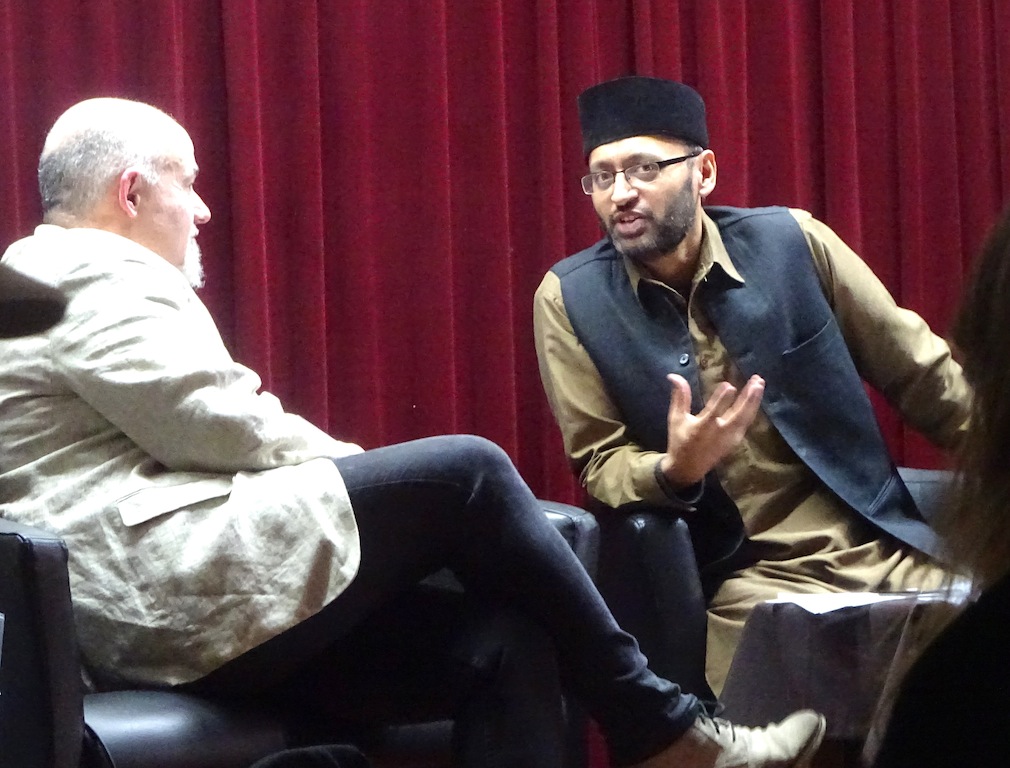
This double need often results in the kind of event I’m delighted to have stumbled on tonight. It’s an evening of poets, some from the mosque, some from the visiting ScriptStuff open mic brigade, reading their work on the theme of peace and it’s being hosted by Leamington’s Ahmadiyyah community in their centre and mosque.

The religious element is not lost entirely as you’d expect given where we are.  The event is top-and-tailed by prayers and words from the spiritual leaders and the performance doesn’t begin until we’ve seen a promo video detailing the history of the Ahmadiyyah community and reiterating its peaceful mission of love for all and hate for none. 

It’s a message - indeed a video - I have encountered before. The last time I came here was for a multi faith response in the wake of the first London Bridge terror attacks. The function of reaching out to the wider community is clearly taken seriously and effectively performed here. A few of the churches I’ve visited could benefit from taking note from this.  Perhaps it’s just a result of the traditions of the community - no religious group does opening the doors, welcoming strangers and providing them with food in the way this community does. I’m befriended by a chap who is as enthusiastic in telling me about the mosque as he is in loudly encouraging readers mid-poem and greeting each completed performance with open-handed slamming of the table top. My quiet attention and polite applause seems awfully timid in contrast.

There’s also a comparison to be seen in the poetry we listen to. The concept of peace as a broad term has many connotations. Peace between nations and religions obviously, but peace too in our inner selves, peace in our relentless misuse of mother nature, peace as a refuge from the maelstrom of modern life. And then there’s the peace we achieve when, we’re told, we discover God and establish a lifelong relationship with him.

It’s noticeable that in general terms the ScriptStuff readers cover the bulk of the secular interpretations while the readers from the Ahmadiyyah community restrict themselves almost exclusively to the last. For the former it’s as if religion and politics are equally responsible for divisions and we have to register our abhorrence of that and call on everyone to make the change for themselves. The latter seem to concentrate, though not absolutely exclusively, on God’s word already being poetry to which we merely must listen.

Within the space of a couple of hours we encounter poetry as protest and poetry as prayer. And bringing those two together is perhaps what this entire evening is about.

For me though, the event has two outstanding contributions. And they come from its two youngest participants. A young Muslim lad whose fabulously moving poem of first-hand persecution stops everyone in their tracks and then the area’s young poet laureate adding her quiet voice to the call for better understanding. 

Having, if nothing else, been tacitly complicit in allowing some of society’s divisions to widen by not doing anything, we’re reminded that the fate of both poetry and peace rest with the young. Their contributions are good news for all. Only the drinks are in danger as my table-thumping neighbour can’t contain his admiration.


Sunday, 16 February 2020

71. St John the Baptist, Baginton


Last week’s reassurances that remaining faithful would see the storm pass were all very well, but as Ciara blustered her way out her friend Dennis was just making an equally powerful entrance. People struggling to repair fence panels blown down in one weekend must have been looking over their shoulders as a second weekend’s battering arrived. Flooded fields and roads have barely had time to subside before another two days of sweeping, heavy, incessant rain. More disruption, more destruction and more people anxious about the approach of flood waters. Plenty, then, to worry about.

I almost didn’t make it to St John the Baptist in Baginton this morning. The route to the village featured a stretch of road where a blown-down tree was blocking half the road followed by a junction which had become a most attractive, though decidedly impassable, lake. Local knowledge got me through only to be rewarded by a fair old soaking between car and church door.

St John is a small church. Only a dozen or so people are here today and, despite an attractive display of children’s work on a table at the side, I may be the youngest here. With the announcement that our vicar today is moving away into a retirement home there must be worries over how this will affect the church.

And worry is the theme for the day. The gospel reading and the sermon which follows explore the nature of worry and entreat us to trust in God and just know that everything will be alright in the end. Faith - any faith, I’d say - makes enormous demands of our trust, but this blanket sidelining of worry in favour of effectively closing your eyes and letting someone else sort it out is, for me, difficult to allow.

I worry too much, I know that. I always have. The psychologist Philippa Perry says anxiety and pessimism is directly linked to the stories you encounter all through your life. After thirty years of reporting car crashes, crime and (increasingly) flood damage, it’s no wonder if during a hymn my thoughts stray to what state my house will be in when I get home. If I get home at all of course. The noise of the rain hammering against the windows doesn’t help.

If you’re not worrying about what can go wrong, these days, you might well find yourself worrying about not having enough going right. Watching the TV I’m bombarded with adverts aimed at making me worry my phone, my holiday, my car, my funeral even should be brighter, bigger or better. Worrying, it would seem, can be big business for someone.

I think the Buddhists have the best approach to getting worrying under control - breaking down the panic, putting things in perspective and then pushing it completely out of the picture. I can’t help but note that this approach comes from within rather than by passing responsibility to someone else, however almighty that person may be. 

Service over, it’s time to brave the dash to the car and the country lanes which have had another hour to worsen. Trying from the inside not to panic while simultaneously trusting to faith, I do safely make it home - but not without having to drive fifty yards on the opposite carriageway’s pavement under a bridge when it became apparent that, for me, this mud red sea would not be parting.


Sunday, 9 February 2020

70. Sunday Worship, BBC Radio 4


Having spent the night being woken by the sound of Storm Ciara tearing up the road outside, then by sweeping rain and house creaks, and finally by my own cough and pounding headache, I decided not to venture out today. Taking a look at the huge seas on the webcams for Brighton and Falmouth I hope my two are safely tucked up too, although I doubt it. Storms aren’t so scary when you’re in your twenties.

In an effort to clear the tubes and perhaps even doze in a chair I was up early and so managed to catch the BBC’s Sunday Worship programme. I’ve been secretly keen to go down this route in recent weeks since the excellent Dave finished the restoration of my 1962 Roberts radio - now proudly displayed atop the piano and offering the few stations it can still pick up on MW and LW.

There is a temptation to think of Sunday Worship as being a bit of an anachronism - a tiny segment of the weekly schedule, marooned in an ocean of world news and serious documentaries, clinging onto its place largely because of a commitment made in an earlier age and now followed only by housebound dotty aunts and ancient grandparents (plus, of course, those trying to escape Storm Ciara).

But in truth it isn’t. The music is more modern than anyone drawing up the religious broadcasting policy back in the day can ever have imagined. There are voices from all round the world offering thoughts and experiences. And storms, fears of spreading viruses and political divisions over Europe come straight from the morning news into the service.

This morning’s live broadcast comes from St Aldates in Oxford and the service takes as its focus the Beatitudes. These eight ‘promises’ are, for me, entirely central to the whole Christian ethic as well as underpinning the foundations of any secular moral life. Be humble and be rewarded; work to foster peace, be merciful and good times will come; grief and hunger will end in comfort. Look for a life with no apparent easy reward and the rewards will come to you, they seem to say. 

These guarantees from the sermon on the mount are backed up today by very modern readers with very modern problems - loss, addiction, aimlessness and so on. Faith, they say, can move any problem, however overwhelming it may appear, into a calmer, more peaceful place. Heady stuff for early Sunday morning but inspiring nonetheless. Sit tight, my radio tells me, and the storm will pass.


Sunday, 2 February 2020

69.St Laurence, Ludlow

Many of the churches and places of worship I’ve visited have left an impression one way or another. Most, it must be said, have left a favourable impression either through their architecture or their welcome; some through the slightly closed nature of what they offer have left a less favourable impression.

The impression left by this visit to the depths of Shropshire will stay with me like no other for wholly unexpected and rather ghastly reasons.

Ludlow’s parish church of St Laurence is a real beauty capping this town on a hill and visible from miles around. Close up it’s less easy to see being snookered from many approaches by a labyrinth of buildings and lanes.

Inside, the church should be a glorious high, open space known for its superb windows, historic organ and for being the resting place of poet AE Housman. But today the interior is cluttered and darkened by the remnants of what looks like a major production of Becket finishing the night before. A vast stage and dangling crown, banks of scaffolding and temporary curtains masking props tables with replica swords and costume rails of historic robes - all of this must be negotiated in an effort to find a way through to the chancel and choral matins. It looks like the set of Midsomer Murders and is the horribly suitable setting for what happened next.


Moments after choosing a seat in the choir the quiet of the church was shattered by a piercing scream and the cries of a woman in obvious distress and pain somewhere back in the nave. At first I feared someone was being attacked or had plummeted from a high gallery. With others I hurried through to discover an older woman who had slipped on the stone floor and, in falling, had fairly evidently broken her hip or her leg. Her agony was obvious and awful and, given the position she was holding her leg, not likely to go away. We tried to calm her and keep her warm. 

An ambulance was called and a consultant who happened to be in the choir ( a stroke of fortune that!) arrived to give the opinion that paramedics were needed and she was best left where she was. Draped under robes from the costume rail she remained in acute pain as, I felt surprisingly, the service carried on further down the church. Just for the record, not a word was said and the poor women didn’t even merit an ad hoc intercession to the Almighty to send some sort of relief right away.

Many things can distract those at a church service from concentrating on the singing or the words being spoken, but I defy anyone to follow a psalm (however beautifully sung by a choir featuring a hospital consultant) or mutter the words of a creed when the whole building reverberates to the sound of someone in evident, vocal distress. By the time I left some fifty minutes later, the ambulance had arrived and some sort of stretcher was being assembled.

If I’m ever back in Ludlow I’d like to visit again on a less dramatic day in every sense. As it was I allowed myself to be ushered out a different way and went on to spend the day with friends watching rugby and then the Super Bowl and inwardly wincing with every crunching collision.


Sunday, 26 January 2020

68. St Charles Borromeo, Hampton on the Hill

One of the motives for starting this blog in the first place (and for keeping it going) has been the excuse for going inside buildings I’ve not been in before. I’ve driven past this church on my way home through Hampton on the Hill many times and always take the opportunity to glance over the wall and see the unique picture.
St Charles Borromeo is an odd, but thoroughly pleasing sight. The church is built on the side of the house, or should that be the other way round? Google for yourself if it’s dates you’re after, the appearance in most appealing however it came into being. The house is now the Presbytery meaning the current incumbent Canon has a very short journey to work and no problem with the regular 9.00am start.
Inside is ample justification for the practice of opening doors you’ve never previously pushed. A small but light T-shaped church with a fabulously ornate altar and surround, it’s an attractive and welcoming space.

And there’s a fair few people here. Over this weekend I’ve been to the Pump Rooms for chamber music and stood behind the goal at St Andrews for songs of an entirely different kind. Both those mutually-exclusive audiences completely suited their respective event. It would be almost impossible not to look at someone and know which event he or she should be at. Here is a third audience and I find myself wondering what Catholics ‘should’ look like and how you’d go about drawing a Venn diagram to display the groupings. Uniquely, I’d guess, I was at all three which either means I belong everywhere or essentially nowhere. Fine thoughts for a Sunday morning.

The mass itself is standard and only two points raise a slight eyebrow. One is the complete absence of musical accompaniment to the hymns, and the other is that in singing hymn numbers 934, 872 and 865 I’m pondering if this is the highest aggregate number ever. There’s bound to be an app, if only I had a smart enough phone.

Tomorrow being Holocaust Memorial Day the homily inevitably touches on thoughts of those unimaginably dark times. Turning our attentions to the establishing of a ghetto in Rome in far earlier times, Canon Stewart urges worshippers to remember that Christians certainly predated and arguably trumped the Nazis in their shameful treatment of the Jewish people. He noted that when the offer was made to Jews living there to remove historic art over-zealously pressing Jews to recognise Christ, the community’s leaders declined. Such forcible attempts to impose one set of beliefs over another were, they said, part of their faith’s history and their removal would lessen our chances of understanding that history and learning its vital lessons. In a world where we’re constantly trying to revise history to suit often short-sighted attempts to ‘move on’ and improve, it’s a thought well worth bearing in mind.